Monday, January 27, 2014

So Where Is Global Warming Now?

It’s cold here in Oklahoma, though not as cold as in many other parts of the country. Of course this would be the day on which I began teaching my general bio class about global warming. Could I have chosen a worse time?

Actually, it was a good time to teach about this subject. Yesterday (Sunday January 26) it was quite balmy, in the 70s F. Overnight the temperature dropped 40 degrees F. So the weather of these last two days perfectly illustrated my point that weather is not climate. You can’t just stick your head out the window and tell whether global warming is occurring or not. You need long-term and large-scale temperature data, which is what the IPCC has accumulated and continues to accumulate.

So where is global warming now? I told my students that this is a good question, one that critical thinkers should be asking, but I have two answers. First, it’s somewhere else at the moment. Down in Australia, where they are having a big tennis competition, some of the tennis shoes of the participants started to melt on the court. Australia is having a record heat wave. Second, it’ll be back. Oklahoma had record heat waves in 2011 and 2012, but not 2013. But the high temperatures will be back. With global climate as well as local weather, the temperatures go up and down and up and down…but they go up more than they go down, and they go up more often than they go down.

Also, I showed the students some of my data regarding tree budburst times in southern Oklahoma. During the period of 2008-2012, the buds of some tree species opened between 2 and 3 days earlier each year. This period is not necessarily typical of all recent time periods, but it really did happen. I have data from lots of trees of numerous species. The advantage of using budburst times is that the plants integrate the weather conditions. They open their buds in response to the overall effect of warm and cold days in the winter, and also in response to lots of other factors, such as drought damage or disease that may have affected them the previous summer. Four hundred budburst data can integrate the effects of thousands of meteorological data for any given year.

So the “polar vortex” created a teachable moment for me today.

This essay will also appear on my blog.

Stan Rice, president

Monday, November 11, 2013

OAS has 102nd Technical Meeting

The Oklahoma Academy of Science met at Cameron University in Lawton for its 102nd Annual Technical Meeting on November 8 and 9, 2013. Think about that. Oklahoma is not a very old state, yet its Academy of Science has had 102 technical meetings. (Technical meetings are for presentations and posters, as opposed to the spring and fall field meetings.) According to Executive Director David Bass, OAS is one of the most active state academies in the United States.

The Executive Council met on Thursday evening, November 8. The Executive Council consists of the Executive Director, the officers, and section chairs. The Council reviewed the (very good) financial condition of OAS, locations of future meetings (watch the OAS website and this blog for updates), participation in the Collegiate Academy (undergraduate papers), and the Junior Academy of Sciences (high school posters in conjunction with the state science fair). The Council also unanimously approved a statement affirming global climate change, which was based on the most recent IPCC report and which affirmed the right and responsibility of Oklahoma scientists to speak out and to teach about global climate change. The Council also agreed to sponsor (in name) another Oklahoma Evolution Road Trip in the summer of 2014. (You can read here about the 2013 road trip, organized by Oklahomans for Excellence in Science Education and sponsored in name by OAS. The permalink is in reverse chronological order; scroll down to the five road trip entries.)

Most of the presentations were on Friday morning, November 9. There were 264 registrants, of which about 240 were present, plus Cameron University undergraduates. Out of the 81 presentations and posters, there were at least 26 undergraduate oral presentations and at least nine undergraduate posters, and five graduate student presentations. There was also a presentation by a high school student.

Since each section independently scheduled presentations, some of us discovered that almost everything happened between 10:00 and 11:00, which included not only presentations but judging. This may explain why some of the sections had very small audiences. As the new president, I would like to consider ways in which this intense concentration of riches into one time period could be spread out a little. If you have ideas, send them to me (srice@se.edu) or to the Executive Director (dbass@uco.edu).

In particular, there were very few participants in the Science Communication and Education section, which should be of interest to everyone in the Academy, since we all teach students and communicate with the public even if we do not have education degrees. One possible reason was that this section conflicted with all the others. This section sponsored a discussion about online courses. The participants agreed that online courses for credit and MOOCs are two very different things, but we need to have a coordinated response to how to use them constructively. Administrators may be open to our ideas rather than just imposing them on us, but we need to present these ideas to them; and what better way to do this than for our statewide Academy of generate these ideas rather than individual faculty or institutions? I would like to have this conversation continue, since the four of us who discussed them represent only a tiny slice of the Academy.

At the Academy business meeting, updates from the Executive Council were announced, and the membership unanimously approved the same statement on global climate change as the Executive Council had approved. This statement will be on the Academy web page soon, and is expected to be endorsed by Oklahomans for Excellence in Science Education (OESE). OESE is more of an activist organization and will be promoting the awareness of global climate change; OAS, as an academy of scientists, has simply gone on record regarding the scientific reality of global climate change.

After the noon banquet, the new president of Cameron University, Dr. John McArthur (a former colleague of mine at Southeastern Oklahoma State University), welcomed the academy. The symbolic gavel of presidency was transferred from outgoing president Craig Clifford to new president Stan Rice; Terry Conley, dean at Cameron, was announced as the president-elect. Left to right: Craig Clifford, Terry Conley, John McArthur.


Terry will take over as president after fall 2015. Dr. Darrin Akin of the University of Oklahoma College of Medicine, told the Academy about the work of INBRE and the importance of Individual Development Plans for student success at every level, including medical school.

Dr. Terry Conley organized a day-long symposium in which eleven speakers examined the Wichita Mountains from many different academic perspectives, whether scientific, social, or artistic. The OAS leadership hopes that such symposia will become a regular part of OAS Technical Meetings. I have organized cross-disciplinary symposia for the national meeting of the Botanical Society of America twice, both times with qualified success: cross-disciplinary symposia are not necessarily the best things for narrowly disciplinary society meetings. But OAS should be the perfect place to have symposia that draw interest from across the sciences and beyond.


Every year, the OAS Technical Meeting is an important event for all of us. For many students, it provides an opportunity to jump into the world of scientific presentations. For many professionals, it provides an opportunity to exchange ideas and hear new perspectives. I know that is what I look forward to most at OAS meetings, including the field meetings. (In photo above, left to right: Ken Hobson, Bill Caire, Gloria Caddell.)

If you missed the meeting, there's always next year, at the Broken Arrow campus of Northeastern Oklahoma State University!

Stan Rice, president

Tuesday, September 17, 2013

Climate Change Workshop blog

I hope as many of you as possible will be able to participate in the Field Meeting. Beavers Bend is a wonderful place and you will love seeing colleagues new and old. I won't be there because I an participating in a workshop this weekend. The Climate Change Workshop this weekend at the University of Oklahoma Biological Station. Sponsored by Oklahomans for Excellence in Science Education (OESE) and the Oklahoma Climatological Survey, this workshop will acquaint high school teachers with the basic facts about climate change and introduce active learning experiences they can use with their students. For many years OESE has held evolution workshops, but we recognized that climate change is just as controversial a topic as evolution, if not more so, and teachers really want some help in approaching this topic. I plan to "live-blog" from the event on my science blog. Last year I "live-blogged" from the OESE evolution workshop; see here. Want some straight and clear information about climate change? Check us out starting Friday evening September 20. Or, for those of you at the field meeting, check us out afterward--or during the meeting, if the sound of the frogs keeps you awake at night and you can find a connection. Stan Rice, president-elect

Monday, September 16, 2013

Great weather forecast for Fall Field Meeting this weekend

The Fall Field Meeting of the OAS is this weekend, at Beaver's Bend State Park in McCurtain County. Many of you have preregistered. But some of you may not have, deciding to hold off until you know what the weather would be. Well, the forecast is for great weather!

Here is what weather.com is predicting:
http://www.weather.com/weather/weekend/Beavers+Bend+State+Park+OK+814:19:US

It is too late to preregister, but make plans to come down on Friday regardless. The on-site registration is only $5 more. Meal tickets are available on a first-come, first-served basis, so it is best to arrive as early Friday evening as possible.

Need help navigating? This link http://goo.gl/maps/Hx7Yp gets you to the Google Maps pin for the park, and from the site you can click on "Get Directions" and enter your starting point.

Tuesday, August 27, 2013

Slide Show for Fall Field Meeting of the OAS

At the Spring Field meeting at Lake Eufala, Dr. Erik Terdal from Northeastern State University gave a slide show to build excitement for the Fall Field Meeting. That meeting is September 20-22 at Beaver's Bend State Park. Here is that slideshow. Note his emphasis on the new air conditioning units in Group Camp 1, where will be staying, in case this heat lasts that long. The photos we all taken over Spring Break, in March, so the plant life will be more luxuriant now. Hope to see you there!
.
http://www.slideshare.net/drterdal/fall-2013-field-meeting


Monday, August 26, 2013

2013 Fall Field Meeting set for Beavers Bend State Park

It is that time of year again.  Time to begin planning to attend the OAS Fall Field Meeting.  This year we’ll be traveling to the far southeast part of the state to explore the natural beauty of Beavers Bend State Park September 20-22.  Established in the 1930’s, Beavers Bend is one of Oklahoma’s oldest and original state parks.  It is a bit of a drive for most in the state; four hours from Oklahoma City, three and a half hours from Tulsa. 

Check out the OAS webpage for registration information and directions Group Camp #1.  Contact Dr. Erik Terdal, (Department of Natural Sciences, Northeastern Oklahoma State University, Broken Arrow, OK 74014, 918-444-3850, terdal@nsuok.edu) for more information.


Monday, June 10, 2013

First Annual Oklahoma Evolution Road Trip a Success

The First Annual Oklahoma Evolution Road Trip was a success! By just about any measure. There were lots of tornadoes and thunderstorms but they all missed us. The participants enjoyed it and learned a lot. And we saw some really interesting things that are unknown even to most educated people, including myself until just the last couple of years before leading this trip. The trip was based at the University of Oklahoma Biological Station. The University of Oklahoma Foundation handled the finances, but the trip paid for itself (just barely). The main sponsor was Oklahomans for Excellence in Science Education. OAS sponsored in name only and so you all deserve to hear how it went.

A detailed account as well as several photos of the trip can be found in the June 6-10 entries on my evolution blog.

We found a lot of fossils from the Paleozoic and Mesozoic eras. Geologic forces in what is now the Arbuckle Mountains pushed up Paleozoic deposits, which then eroded, with the result that the oldest layers are at the top of the Arbuckles and younger ones on the slopes. We saw everything from Cambrian stromatolites to Ordovician crinoids. During the Pennsylvanian period, a big chunk of crust collapsed and was filled in with rubble, resulting in an abrupt change from Ordovician limestone to Pennsylvanian conglomerate. And then lots of Cretaceous marine sediments were laid down. The Kiamichi limestone, for example, had more fossils than matrix, and most of the fossils were just one species, a bivalve named Texigryphaea navia. In other Cretaceous limestones we saw sand dollars, ammonoids, etc. Oklahoma is renowned for creationism, yet the fossils that confirm evolution are literally washing out of the hills. We also visited Goddard Youth Camp, where the museum contains a cast of the most complete Acrocanthosaurus skeleton ever found (it was found in eastern Oklahoma).

Dr. Gordon Eggleton, retired physical sciences professor from Southeastern, led the geology part of the trip. I showed the participants different species of trees that had different life cycle adaptations. So between the two of us, Gordon and I covered both the living and the dead world.


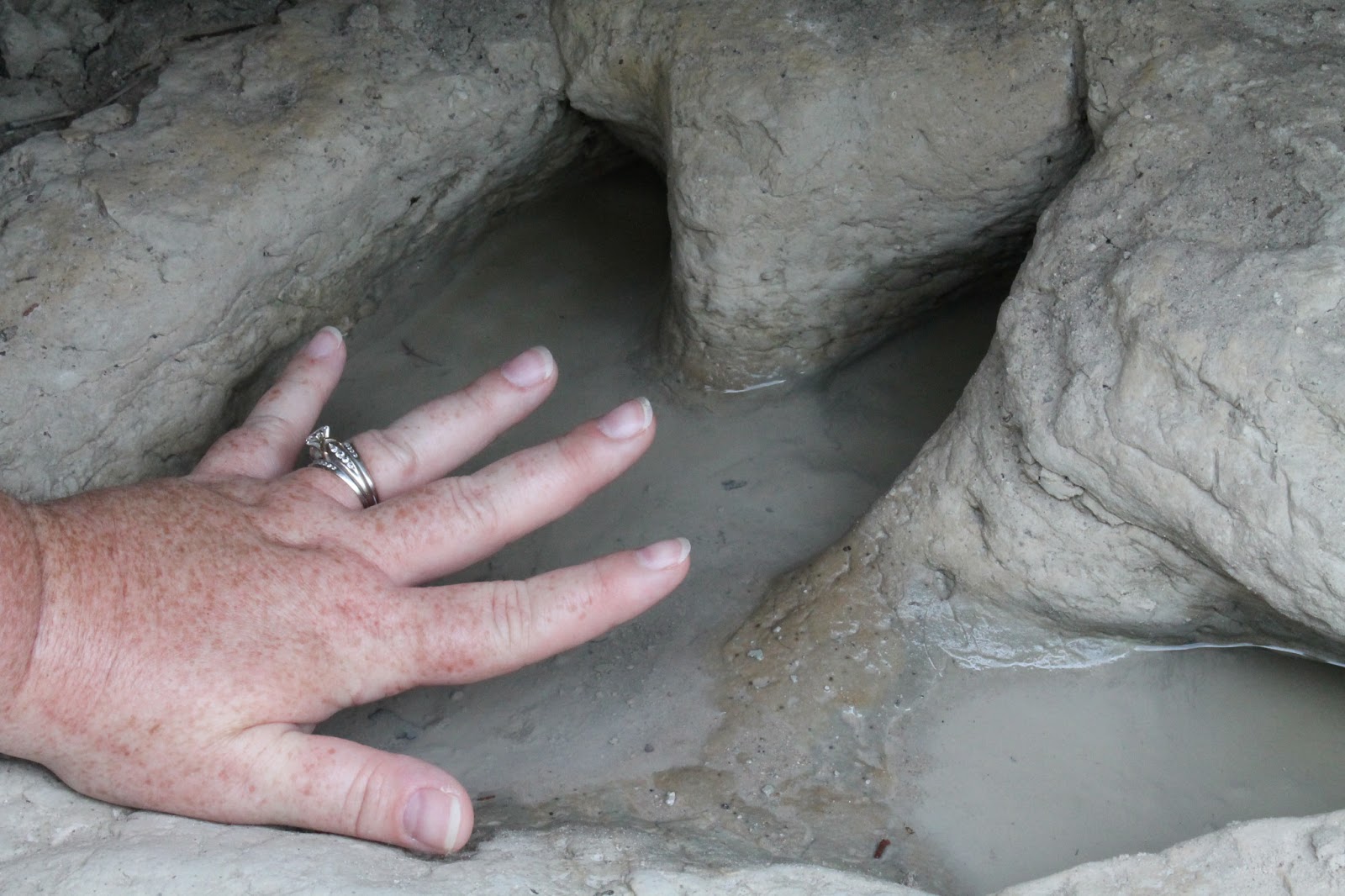
We also drove down into Texas to see dinosaur footprints in the bed of the Paluxy River and visit a creationist museum that is infamous even among creationists.


Notice that, according to the creationist museum, the acrocanthosaur with razor sharp teeth (and which is attacking Mary Kay Johnston, a professor from Austin, TX) was herbivorous.

One could not hope for a better group of participants: high school teachers, both new and retired; college professors, both current and retired; and other interested people. There were ten participants and two instructors, a total of 12 crammed into what we were told was supposed to be a 15 person van.


You can bet that I will be trying to organize more such trips in the future.

I hope you all have as interesting a summer as I am having. And please do not hesitate to post things on this blog that you think we would be interested in hearing.

Stanley Rice
President-elect