Showing posts with label fossils. Show all posts

Monday, April 13, 2015

Spring 2015 Field Meeting

The Oklahoma Academy of Science had its spring field meeting this past weekend at Sequoyah State Park near Muskogee. If you missed it, this essay will help you regret it. Fortunately we missed the torrential rains that started falling today. It was gently cool, and softly overcast—which made the green of the new leaves very intense. On Saturday morning and afternoon we had field trips. I accompanied Gloria Caddell for the botany hikes.


We saw beautiful and interesting plants. Examples include the mayapple (Podophyllum peltatum in the Berberidaceae):


And spiderwort (Tradescantia ernestiana in the Commelinaceae):


We also saw the mycotrophic orchid Corallorhiza wisteriana. It does not have chlorophyll. It gets its nutrition from decaying wood. But not directly. It is mycotrophic rather than saprophytic because mutualistic fungi absorb the nutrients from rotting wood and provide them to the orchid.


On one of our hikes we visited a nearby Boy Scout camp owned and operated by the family of Andrea Blair, a graduate student at Oklahoma State University Tulsa campus. Here, Andrea is talking with Ken Hobson, former president of OAS and professor of biology at OU.


We saw a magnificently blooming buckeye (Aesculus glabra in the Hippocastanaceae). But it was on the other side of the creek so I had to wade across to get photos of it. This would have been a simple matter except that the rocks were just the right size to hurt my tender old feet.


Among the student participants was John Williams and his sons and nephew from Southeastern Oklahoma State University. Mia Revels of Northeastern Oklahoma State University and Gloria Caddell of University of Central Oklahoma brought their classes (ornithology and systematic botany, respectively). The photo shows John's young son soaking up the wonders of the forest.


Especially in the afternoon, the field trips combined forces to gain a multi-disciplinary view of nature. Liz Bergey of OU found a slime mold. And we all wished for a competent paleontologist when we found abundant fossils near the lake shore. In this photo, you can see many crinoids (a kind of echinoderm, with stalks that look like stacks of coins), corals, and bryozoans (now known as ecoprocts). The bryozoans were of the genus Archimedes and looked more like a fish backbone. That’s what I thought they were at first, but I never saw any “fish ribs” with the “backbones,” which meant I had to be wrong.


On Friday and Saturday evenings, guest speakers provided fascinating presentations. On Friday, Charles Brown of University of Tulsa told us about his over three decades of research into the costs, benefits, and evolution of colony behavior in cliff swallows. You think you’ve had bedbugs? But a single little swallow nest can have hundreds of them. On Saturday, Ron Bonett of University of Tulsa told us about salamanders in Oklahoma, and about the repeated evolution of species in which juveniles become sexually reproductive. In the photo, field meeting organizer Connie Murray (of Tulsa Community College Metro campus) talks with Charles Brown.


Every spring and fall, OAS has wonderful field meetings. There are always lots of interesting things to see, and wonderful people to explore with. My thanks to everyone who made the meeting a success, including our Executive Director David Bass who had to make sure everything happened.

Stan Rice, president

Friday, September 26, 2014

Another World at Black Mesa: Oklahoma Academy of Science field meeting, a botany trip

This is the second entry about the Field Meeting at Black Mesa last weekend. The first was from the field meeting organizer, Marco Micozzi; scroll down to see his essay and photo. This second entry was written by the president, Stan Rice.

On September 19, 2014, hundreds of people hit the road and headed out through the Panhandle of Oklahoma as if being shot through the barrel of a rifle. We came to rest right at the very tip, at Black Mesa State Park. Black Mesa is like a different world, more closely resembling New Mexico than any part of Oklahoma with which most of us are familiar. As we left most of the trees, and even many of the shrubs, behind, we knew that we were also leaving behind comfort and safety. We were exposing ourselves not only to stormy weather (which, despite predictions, did not materialize) and almost desert-like conditions, but also to biological dangers, everything from rattlesnakes to hantavirus. Hantavirus has already claimed lives in the Panhandle.


What surprised me most about this meeting is that there were over a hundred undergraduate students. As president, I had begun to worry that perhaps OAS was becoming a coterie of old people. But the average age of the people at this meeting must have been about twenty, despite the considerable statistical leverage provided by seasoned individuals such as Craig Clifford, David Bass, and myself. I can only hope this means that science is alive and well in the next generation of Oklahomans. Of course, they will probably all find jobs in other states where the pay is better.

Once we all got settled down in our bunkhouses and tents, we had dinner provided by a caterer who was actually willing to drive all the way out to Black Mesa. I am still amazed that any caterer would be willing to do this.

Our evening program was a presentation by Dr. Anne Weil of OSU.


She teaches anatomy in medical school during the academic year, and does vertebrate paleontology research in summer. She studies dinosaurs and ancient mammals. The land that is now Oklahoma had some truly amazing dinosaurs. She handed around what appeared to be pieces of rock. But they were fossilized dinosaur bone fragments. Even after being told what they were, I could not tell that they were anything other than rocks, except for one, which clearly had fossilized bone tissue in it. She conveyed to us some of the excitement of scientific research, often punctuated with “Yay!” and “Woo!” By using microscopes and isotopes, Anne said, we can ask and answer questions that Cuvier could not even imagine.


In the next entry, I will write about a couple of the field trips in the vicinity of, and up to the top of, Black Mesa, on Saturday, September 20. I remind the field trip leaders that if you were on other trips, please send me a summary of what you saw, plus photos, so I can post them on this blog.

Monday, June 10, 2013

First Annual Oklahoma Evolution Road Trip a Success

The First Annual Oklahoma Evolution Road Trip was a success! By just about any measure. There were lots of tornadoes and thunderstorms but they all missed us. The participants enjoyed it and learned a lot. And we saw some really interesting things that are unknown even to most educated people, including myself until just the last couple of years before leading this trip. The trip was based at the University of Oklahoma Biological Station. The University of Oklahoma Foundation handled the finances, but the trip paid for itself (just barely). The main sponsor was Oklahomans for Excellence in Science Education. OAS sponsored in name only and so you all deserve to hear how it went.

A detailed account as well as several photos of the trip can be found in the June 6-10 entries on my evolution blog.

We found a lot of fossils from the Paleozoic and Mesozoic eras. Geologic forces in what is now the Arbuckle Mountains pushed up Paleozoic deposits, which then eroded, with the result that the oldest layers are at the top of the Arbuckles and younger ones on the slopes. We saw everything from Cambrian stromatolites to Ordovician crinoids. During the Pennsylvanian period, a big chunk of crust collapsed and was filled in with rubble, resulting in an abrupt change from Ordovician limestone to Pennsylvanian conglomerate. And then lots of Cretaceous marine sediments were laid down. The Kiamichi limestone, for example, had more fossils than matrix, and most of the fossils were just one species, a bivalve named Texigryphaea navia. In other Cretaceous limestones we saw sand dollars, ammonoids, etc. Oklahoma is renowned for creationism, yet the fossils that confirm evolution are literally washing out of the hills. We also visited Goddard Youth Camp, where the museum contains a cast of the most complete Acrocanthosaurus skeleton ever found (it was found in eastern Oklahoma).

Dr. Gordon Eggleton, retired physical sciences professor from Southeastern, led the geology part of the trip. I showed the participants different species of trees that had different life cycle adaptations. So between the two of us, Gordon and I covered both the living and the dead world.


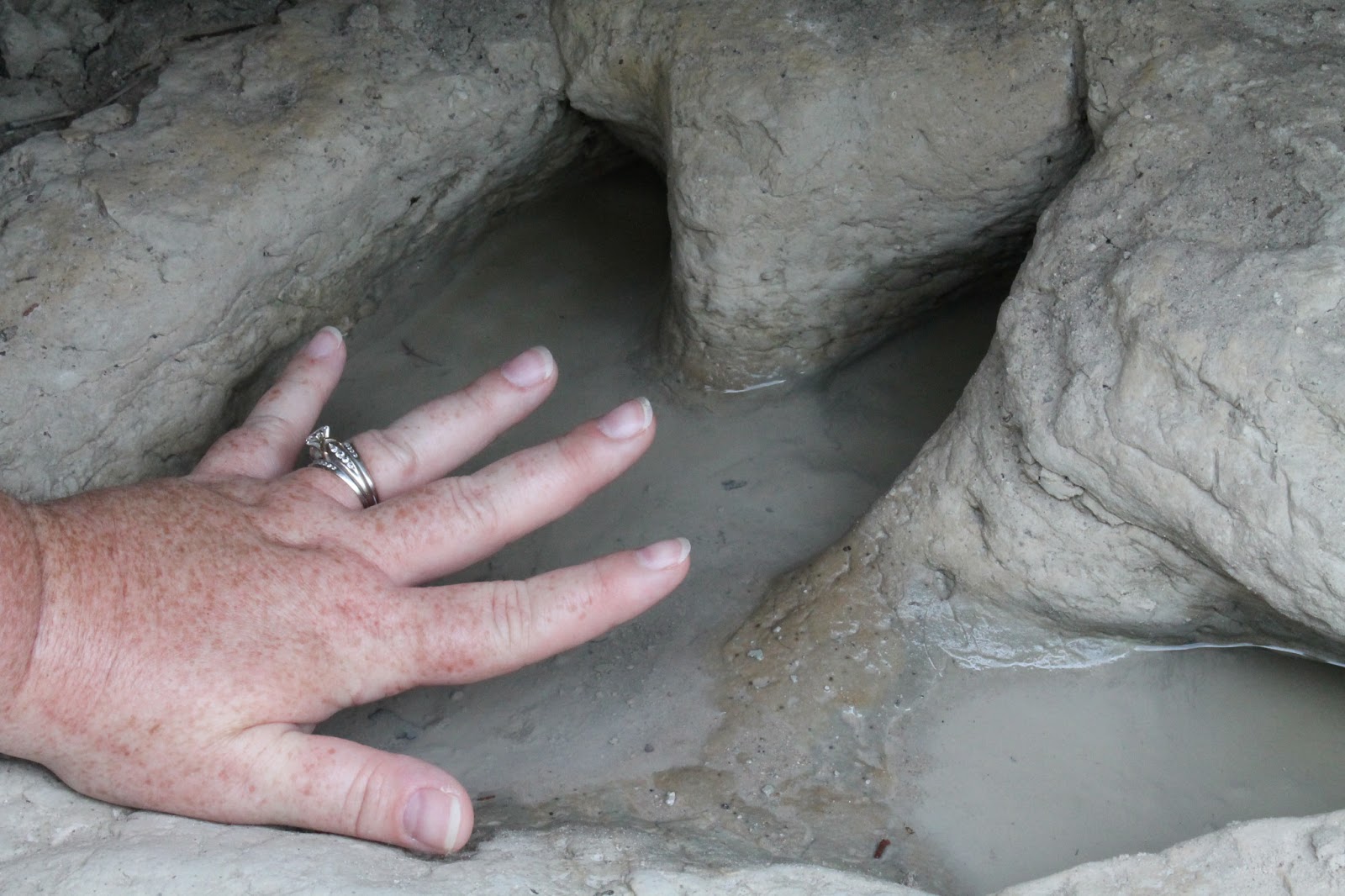
We also drove down into Texas to see dinosaur footprints in the bed of the Paluxy River and visit a creationist museum that is infamous even among creationists.


Notice that, according to the creationist museum, the acrocanthosaur with razor sharp teeth (and which is attacking Mary Kay Johnston, a professor from Austin, TX) was herbivorous.

One could not hope for a better group of participants: high school teachers, both new and retired; college professors, both current and retired; and other interested people. There were ten participants and two instructors, a total of 12 crammed into what we were told was supposed to be a 15 person van.


You can bet that I will be trying to organize more such trips in the future.

I hope you all have as interesting a summer as I am having. And please do not hesitate to post things on this blog that you think we would be interested in hearing.

Stanley Rice
President-elect