Showing posts with label Oklahomans for Excellence in Science Education. Show all posts

Friday, March 7, 2014

Coming Right Up! The Second Annual Oklahoma Evolution Road Trip!

Posted by Stan Rice, President

Last summer we had the First Annual Oklahoma Evolution Road Trip, with ten participants and two instructors. Well, we have a Second Annual Oklahoma Evolution Road Trip scheduled for April 26-27 in Tulsa.

Oklahoma Academy of Science is one of the sponsors of this trip. Watch this space also for an announcement about the OAS Spring field meeting!

The Oklahoma Evolution Road Trips are open to anyone who is interested in learning more about evolution and the evidence for it that can be seen right here in Oklahoma. (Last year we included Texas as well.) You don’t need a science background, just a willingness to observe and learn. It is specifically intended for science teachers, who can receive a certificate of professional development credit. Registration cost is $95. Online registration will be available soon through the Oklahoma Science Teachers Association—I will keep you posted! If you are interested, block off these dates in your schedule now!

Because this is a serious learning experience, young children are not encouraged to participate, although there can always be exceptions. This sounds like the kind of trip I would have loved when I was twelve years old, but that few other twelve-year-olds would have appreciated.

The $95 cost covers transportation during the trip, refreshments on both mornings, and lunches on both days. It does not include accommodations (which most participants will not require) or the evening meal for those who wish to participate in it. Participants who need accommodations can let me know as soon as possible and, if there are enough of you, I will try to get a group discount.

Last summer, the trip was longer and more expensive because it was in a location more distant from Oklahoma metropolitan areas. I believe we would have had more teachers in the group had the cost and location been more convenient. Well, we have solved that problem for 2014.

The two instructors will be myself (Dr. Stanley Rice), a biology professor at Southeastern Oklahoma State University, and Cora James, the science curriculum director for Putnam City Schools and a good amateur geologist. I am the author of four nationally and internationally published science books, two of which are about evolution. Both instructors bring a lot of experience with how to make science, and especially evolution, interesting and relevant to the school classroom in such a way as to highlight the positive learning experiences rather than to create tension and conflict.


The Second Annual Oklahoma Evolution Road Trip now has four professional organizations sponsoring it! The sponsors are:

·         Society for the Study of Evolution (Education Committee)
·         Oklahomans for Excellence in Science Education
·         Oklahoma Science Teachers Association
·         Oklahoma Academy of Science

The first of the organizations is one of the leading scientific societies in the world and has sponsored and provided financial support for this trip through a competitive grant. The other three organizations are the major professional organizations for science education in the state.

Here are the things we are going to do on this trip:

Saturday morning, April 26. We will meet at the Martin Regional Library in Tulsa (2601 S. Garnett) for a discussion about what the participants know, and what they want to know, about evolution, including: the rapid evolution that is now going on in viruses and bacteria; the new DNA evidence for the evolutionary ancestry of organisms, including humans; and the ongoing discovery of geological evidence (especially fossils) for evolution. We will also learn about the geological history of what is now Tulsa, right up to the last Ice Age, and how fossils form.

Saturday afternoon, April 26. After a catered light lunch, we will get into vans to go find our own fossils. (Participants can leave their vehicles at the library.) Bring plastic bags for collecting fossils (the instructors will have some for you also). We will go out rain or shine, unless the weather is actually dangerous. Individual vehicles are discouraged because of limited parking in some places. Our destinations are:

1. A location on Highway 51 where Ordovician fossils are washing out of loose rock. You can find mostly crinoids but also an occasional trace fossil (fossilized track). A crinoid is a stalked echinoderm. The traffic can be heavy but where is plenty of space to keep away from the vehicles. This is public easement and you can collect fossils.

2. Lake Skiatook. At one location on this lake maintained by the Army Corps of Engineers, there are numerous fossils of crinoids and brachiopods. Brachiopods have been rare for the last 250 million years but were common during the Ordovician period. They looked a lot like mollusks. Fossil collecting is also allowed here.


Arkansas River. The bed of the Arkansas River, usually mostly dry, contains a lot of things washed in from surrounding places; you can never be sure where they have come from. Most of it is garbage, but once in a while you can find coal, or even fossils such as this crinoids that got washed downstream from some unknown source. Of course, you can keep whatever you find.


For those who wish to continue discussion on Saturday evening, we can meet at a restaurant. (The registration fee does not cover this cost.)

On Sunday morning, April 27, we will meet again at the parking lot of the library (which will be closed at that time), but where participants can leave their vehicles. We will go by van out to Red Bud Valley northeast of Tulsa where we will walk around most of the morning on the bluff trails.

If you know where to look, you can find fossils, such as this amazing brachiopod fossil I found last summer. Collecting is not permitted here, although if you find something interesting the visitors’ center will be happy to get it for their displays.


We will also learn about tree adaptations. There are many, many different evolutionary adaptations, each one appropriate for its own set of conditions. For cottonwoods, living in flood plains, this means rapid growth, cheap wood, and a short life. For oaks, living in stable forests, this means slow growth, strong wood, and a long life. Tree ranges also shift during evolutionary time, and in Red Bud Valley there are some trees, such as sugar maples, smoke trees, and blue ashes, that were very common in Oklahoma thousands of years ago but have mostly died off—except in this little sheltered spot. You see, evolution is not just something that happened in the past and that you can study with fossils; it is ongoing, and you can see it in the trees around you.


During a catered light lunch in the shaded parking lot at Red Bud Valley, we can discuss what we have seen, and then go back to the library parking lot. Participants will be able to leave by 3:00 at the latest on Sunday afternoon.

A word about next year’s Third Annual Oklahoma Evolution Road Trip: Plans are underway for this trip to be offered for college credit through the Oklahoma Scholar Leader Enrichment Program (OSLEP) during Spring Break 2015, housed (like the 2013 trip) at the University of Oklahoma Biological Station on Lake Texoma. Depending on the success of this year’s trip, we hope to offer the cheap and short version of the trip on alternate years, so the next two-day trip in an Oklahoma metropolitan area should take place in 2016.


Please watch this spot for announcements about online registration, which we hope to begin (along with public radio announcements) about March 17.

Monday, June 10, 2013

First Annual Oklahoma Evolution Road Trip a Success

The First Annual Oklahoma Evolution Road Trip was a success! By just about any measure. There were lots of tornadoes and thunderstorms but they all missed us. The participants enjoyed it and learned a lot. And we saw some really interesting things that are unknown even to most educated people, including myself until just the last couple of years before leading this trip. The trip was based at the University of Oklahoma Biological Station. The University of Oklahoma Foundation handled the finances, but the trip paid for itself (just barely). The main sponsor was Oklahomans for Excellence in Science Education. OAS sponsored in name only and so you all deserve to hear how it went.

A detailed account as well as several photos of the trip can be found in the June 6-10 entries on my evolution blog.

We found a lot of fossils from the Paleozoic and Mesozoic eras. Geologic forces in what is now the Arbuckle Mountains pushed up Paleozoic deposits, which then eroded, with the result that the oldest layers are at the top of the Arbuckles and younger ones on the slopes. We saw everything from Cambrian stromatolites to Ordovician crinoids. During the Pennsylvanian period, a big chunk of crust collapsed and was filled in with rubble, resulting in an abrupt change from Ordovician limestone to Pennsylvanian conglomerate. And then lots of Cretaceous marine sediments were laid down. The Kiamichi limestone, for example, had more fossils than matrix, and most of the fossils were just one species, a bivalve named Texigryphaea navia. In other Cretaceous limestones we saw sand dollars, ammonoids, etc. Oklahoma is renowned for creationism, yet the fossils that confirm evolution are literally washing out of the hills. We also visited Goddard Youth Camp, where the museum contains a cast of the most complete Acrocanthosaurus skeleton ever found (it was found in eastern Oklahoma).

Dr. Gordon Eggleton, retired physical sciences professor from Southeastern, led the geology part of the trip. I showed the participants different species of trees that had different life cycle adaptations. So between the two of us, Gordon and I covered both the living and the dead world.


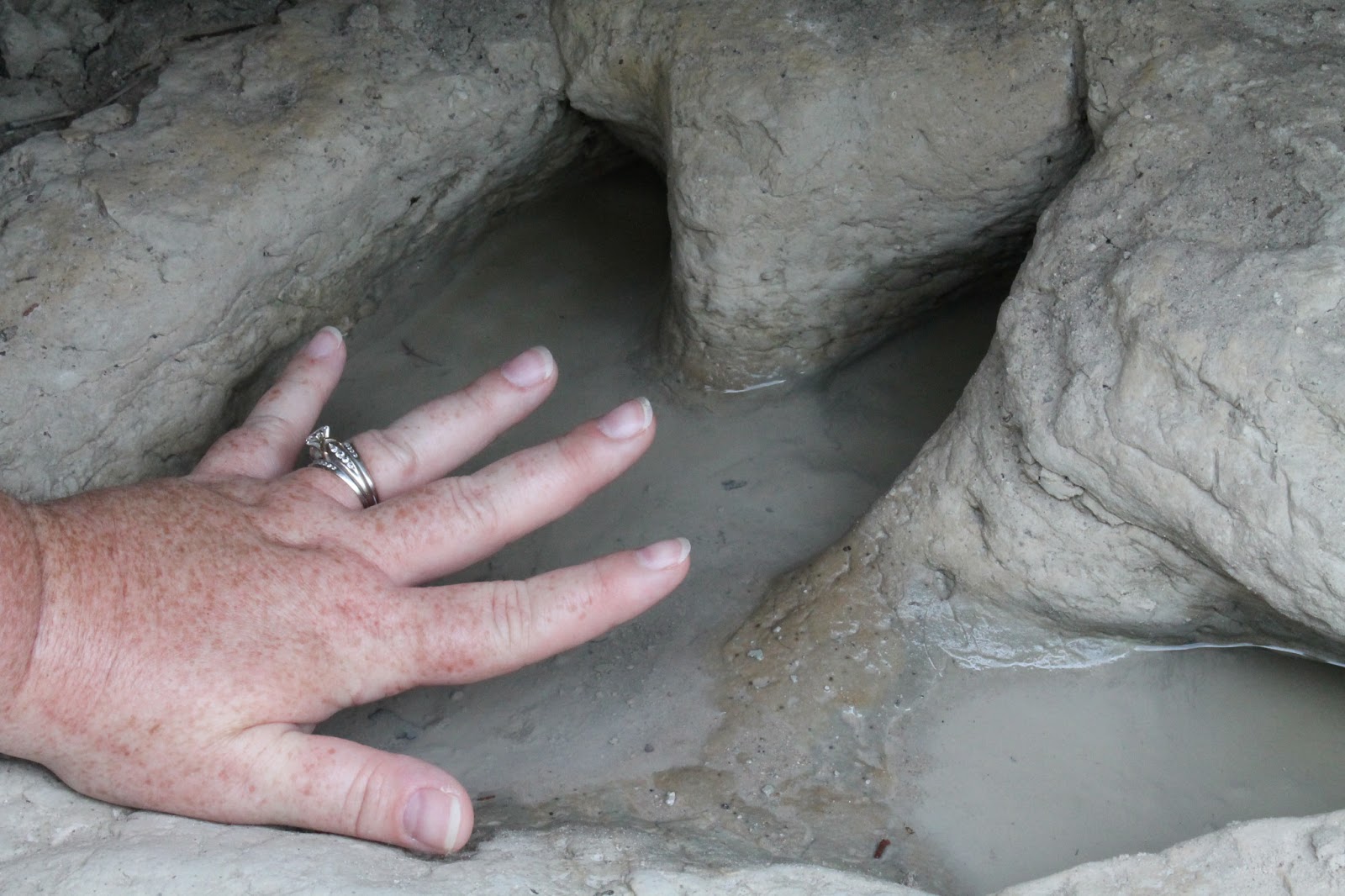
We also drove down into Texas to see dinosaur footprints in the bed of the Paluxy River and visit a creationist museum that is infamous even among creationists.


Notice that, according to the creationist museum, the acrocanthosaur with razor sharp teeth (and which is attacking Mary Kay Johnston, a professor from Austin, TX) was herbivorous.

One could not hope for a better group of participants: high school teachers, both new and retired; college professors, both current and retired; and other interested people. There were ten participants and two instructors, a total of 12 crammed into what we were told was supposed to be a 15 person van.


You can bet that I will be trying to organize more such trips in the future.

I hope you all have as interesting a summer as I am having. And please do not hesitate to post things on this blog that you think we would be interested in hearing.

Stanley Rice
President-elect

Tuesday, April 16, 2013

Oklahoma Evolution Road Trip!

Time is running short to register for the Oklahoma Evolution Road Trip! It is May 30 through June 2 and costs $350 which includes travel, accommodations, and most meals. (The cost is $400 if you prefer single accommodations.) This is a real bargain; a recent Big Bend ecotour of similar length cost almost $3000. Home base is the University of Oklahoma Biological Station on beautiful Lake Texoma. We will see fossil deposits, dinosaur footprints, and living trees, and visit creationist museums. There will be plenty of time for discussion. Dr. Stanley Rice and Dr. Gordon Eggleton, both of Southeastern Oklahoma State University, will lead the trip. The tentative deadline is May 3, though we may extend this upon request. Pre-college teachers will receive professional development credit. More information, and registration information, is available at http://www.ou.edu/uobs/evolution.html as well as at Dr. Rice’s blog (http://www.honest-ab.blogspot.com) and website (http://www.stanleyrice.com). If necessary you may attend for just part of the trip, although registration costs remain the same. We’ve talked about evolution; now let’s go see some stunning evidence for it!

The trip is organized by Oklahomans for Excellence in Science Education and is an activity endorsed by OAS. It should be especially valuable for science educators. As always in OESE and OAS events, there will be wonderful people to talk with.

This will not be a creation vs. evolution debate event. When we visit creationist museums, we will listen to them and ask questions, which we will discuss by ourselves later.

Help spread the word to people you know who may be interested. Tax-deductible donations are accepted by the University of Oklahoma Foundation (see the registration website) to help pre-college science teachers.

See you at the Field Meeting! Let's post photos and information about what we see at Lake Eufala after we get home. If you are a board member who has misplaced the login information, contact me (srice@se.edu) and I will send it to you.

Saturday, November 10, 2012

The Fall Technical Meeting 2012 You Should Have Been There

The Fall 2012 Technical Meeting of the Oklahoma Academy of Science was the place to be on November 9. There were more registrants and more presentations than in many recent meetings. The meeting was at the Nigh Center on the campus of the University of Central Oklahoma at Edmond. It is always inspiring to see such a concentration of talent and passion for science in science students and faculty in our state. Some people think that Oklahoma has little science in it. But they would be wrong, and there is no better place to see it than at the Oklahoma Academy of Science. OAS is grateful to UCO for hosting this meeting.

There were many student and faculty presentations, in over a dozen different fields of science, from botany to zoology to engineering to microscopy to engineering.

Below are some photos of people that you may recognize: Craig Clifford, president, and Valerie O'Brien, secretary; Executive Director David Bass explaining the budget; Sheila Strawn, Ken Hobson, and Adam Ryburn.

Vic Hutchison, Professor Emeritus at OU, gave the keynote presentation. Vic is the grand old man of defending science education in Oklahoma. He told us about the work of Oklahomans for Excellence in Science Education, which for many years has worked against creationist legislation in Oklahoma. Vic and OESE have gained national recognition for these efforts. Creationist legislation has so far been cut down whenever it appears, but it sort of seems like hydra-heads, always reappearing. It looks as if the people who oppose evolution the most do not know what it is, because they have allowed "natural selection" and "change through time" to be included in Oklahoma secondary school teaching standards. OESE has sponsored many workshops for teachers, and has recently expanded into north Texas and will soon focus on global climate change as well as evolution. Oklahoma has been privileged to have Vic Hutchison working for us. The final photo is of his presentation.

Posted by Stanley Rice, president-elect, OAS


Monday, May 14, 2012

Global warming information session in Tulsa on May 17

The Oklahoma Academy of Science is one of the sponsors of a global warming information session that will take place in the Aaronson Auditorium of the Central Library in downtown Tulsa on Thursday, May 17, from 6:30 to 8:30 pm. The other sponsor is Oklahomans for Excellence in Science Education.

Dr. Stanley Rice will give a presentation and then lead a discussion about global warming. I am the author of several science books. Two of them (Green Planet: How Plants Keep the Earth Alive and Encyclopedia of Biodiversity) have extensive coverage of global warming. A PDF file of the text of the presentation will be available on my website under “presentations” shortly before the session.

Global warming is beginning to surpass evolution as the hot topic of science education today, and that is why OAS and OESE are interested in it. As with creationism, global warming denialism is based on inaccurate science and often on religious assertions that have no clear connection with religious tradition. In addition, there is a strong motivation by some industry groups to deny global warming. At the same time, many other industries are ready to pursue clean energy, and many religious groups want to protect what they see as God’s creation from damage caused by humans.

My professional connection to the science of global warming is that I have a multi-year study of the effects of climate change on budburst times in deciduous trees, and I studied the effects of carbon dioxide on plant growth when I was in graduate school.

The event is free and open to the public. Expect a diverse crowd: the Tulsa geologists (many of whom are petroleum geologists) have been invited to participate in the audience and discussion.

Posted by: Stanley Rice, president-elect