Tuesday, September 17, 2013
Climate Change Workshop blog
I hope as many of you as possible will be able to participate in the Field Meeting. Beavers Bend is a wonderful place and you will love seeing colleagues new and old. I won't be there because I an participating in a workshop this weekend. The Climate Change Workshop this weekend at the University of Oklahoma Biological Station. Sponsored by Oklahomans for Excellence in Science Education (OESE) and the Oklahoma Climatological Survey, this workshop will acquaint high school teachers with the basic facts about climate change and introduce active learning experiences they can use with their students. For many years OESE has held evolution workshops, but we recognized that climate change is just as controversial a topic as evolution, if not more so, and teachers really want some help in approaching this topic. I plan to "live-blog" from the event on my science blog. Last year I "live-blogged" from the OESE evolution workshop; see here. Want some straight and clear information about climate change? Check us out starting Friday evening September 20. Or, for those of you at the field meeting, check us out afterward--or during the meeting, if the sound of the frogs keeps you awake at night and you can find a connection. Stan Rice, president-elect

Monday, September 16, 2013
Great weather forecast for Fall Field Meeting this weekend
The Fall Field Meeting of the OAS is this weekend, at Beaver's Bend State Park in McCurtain County. Many of you have preregistered. But some of you may not have, deciding to hold off until you know what the weather would be. Well, the forecast is for great weather!
Here is what weather.com is predicting:
http://www.weather.com/weather/weekend/Beavers+Bend+State+Park+OK+814:19:US
It is too late to preregister, but make plans to come down on Friday regardless. The on-site registration is only $5 more. Meal tickets are available on a first-come, first-served basis, so it is best to arrive as early Friday evening as possible.
Need help navigating? This link http://goo.gl/maps/Hx7Yp gets you to the Google Maps pin for the park, and from the site you can click on "Get Directions" and enter your starting point.
Tuesday, August 27, 2013
Slide Show for Fall Field Meeting of the OAS
At the Spring Field meeting at Lake Eufala, Dr. Erik Terdal from Northeastern State University gave a slide show to build excitement for the Fall Field Meeting. That meeting is September 20-22 at Beaver's Bend State Park. Here is that slideshow. Note his emphasis on the new air conditioning units in Group Camp 1, where will be staying, in case this heat lasts that long. The photos we all taken over Spring Break, in March, so the plant life will be more luxuriant now. Hope to see you there!
.
http://www.slideshare.net/drterdal/fall-2013-field-meeting
.
http://www.slideshare.net/drterdal/fall-2013-field-meeting
Monday, August 26, 2013
2013 Fall Field Meeting set for Beavers Bend State Park
It is that time of year again. Time to begin planning to attend the OAS Fall
Field Meeting. This year we’ll be
traveling to the far southeast part of the state to explore the natural beauty
of Beavers
Bend State Park September 20-22. Established
in the 1930’s, Beavers Bend is one of Oklahoma’s oldest and original state
parks. It is a bit of a drive for most in
the state; four hours from Oklahoma City, three and a half hours from Tulsa.
Check out the OAS
webpage for registration information and directions Group Camp #1. Contact Dr. Erik Terdal, (Department of
Natural Sciences, Northeastern Oklahoma State University, Broken Arrow, OK 74014, 918-444-3850, terdal@nsuok.edu)
for more information.
Monday, June 10, 2013
First Annual Oklahoma Evolution Road Trip a Success
The First Annual Oklahoma Evolution Road Trip was a success! By just about any measure. There were lots of tornadoes and thunderstorms but they all missed us. The participants enjoyed it and learned a lot. And we saw some really interesting things that are unknown even to most educated people, including myself until just the last couple of years before leading this trip. The trip was based at the University of Oklahoma Biological Station. The University of Oklahoma Foundation handled the finances, but the trip paid for itself (just barely). The main sponsor was Oklahomans for Excellence in Science Education. OAS sponsored in name only and so you all deserve to hear how it went.
A detailed account as well as several photos of the trip can be found in the June 6-10 entries on my evolution blog.
We found a lot of fossils from the Paleozoic and Mesozoic eras. Geologic forces in what is now the Arbuckle Mountains pushed up Paleozoic deposits, which then eroded, with the result that the oldest layers are at the top of the Arbuckles and younger ones on the slopes. We saw everything from Cambrian stromatolites to Ordovician crinoids. During the Pennsylvanian period, a big chunk of crust collapsed and was filled in with rubble, resulting in an abrupt change from Ordovician limestone to Pennsylvanian conglomerate. And then lots of Cretaceous marine sediments were laid down. The Kiamichi limestone, for example, had more fossils than matrix, and most of the fossils were just one species, a bivalve named Texigryphaea navia. In other Cretaceous limestones we saw sand dollars, ammonoids, etc. Oklahoma is renowned for creationism, yet the fossils that confirm evolution are literally washing out of the hills. We also visited Goddard Youth Camp, where the museum contains a cast of the most complete Acrocanthosaurus skeleton ever found (it was found in eastern Oklahoma).
Dr. Gordon Eggleton, retired physical sciences professor from Southeastern, led the geology part of the trip. I showed the participants different species of trees that had different life cycle adaptations. So between the two of us, Gordon and I covered both the living and the dead world.


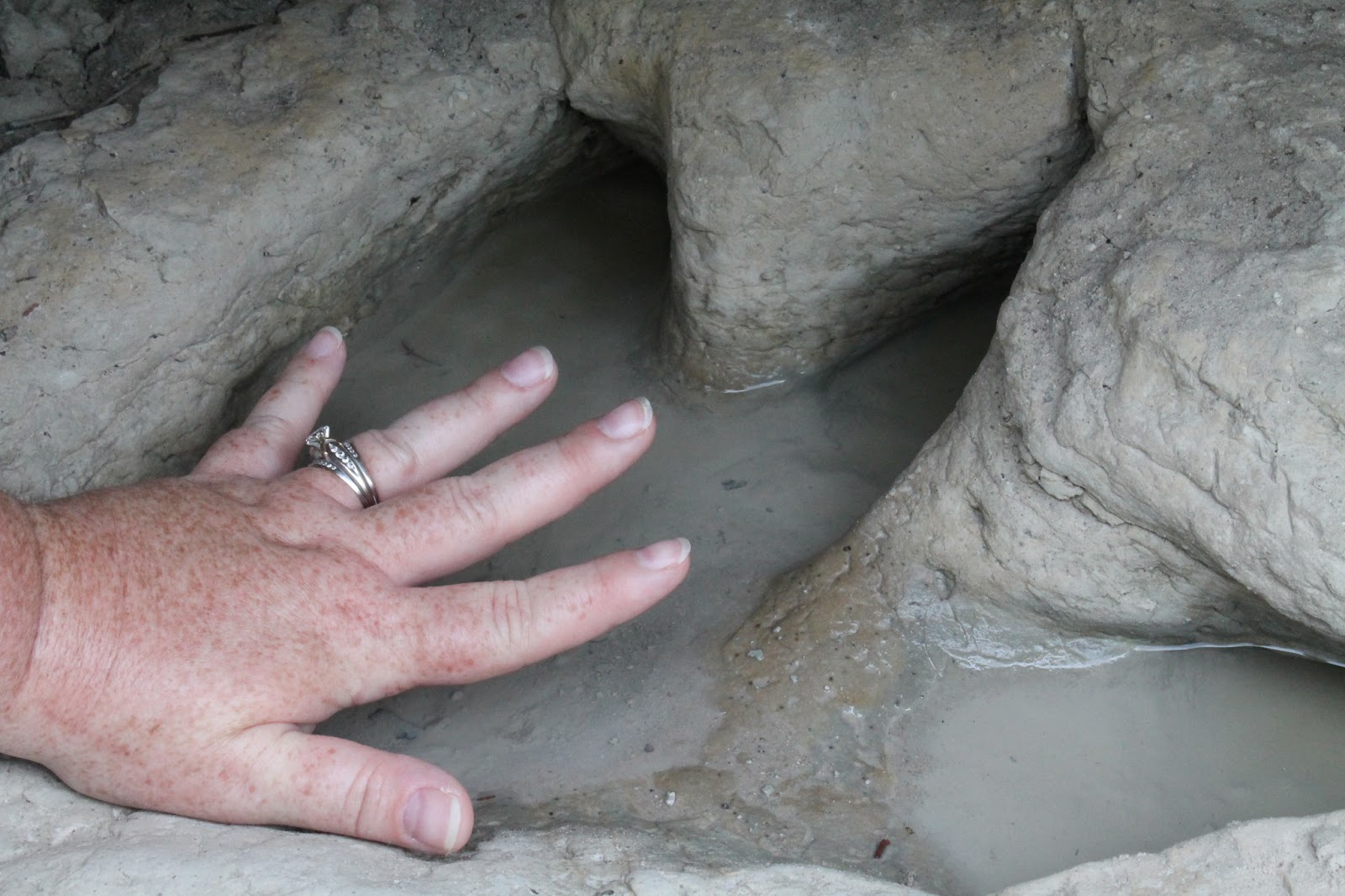
We also drove down into Texas to see dinosaur footprints in the bed of the Paluxy River and visit a creationist museum that is infamous even among creationists.


Notice that, according to the creationist museum, the acrocanthosaur with razor sharp teeth (and which is attacking Mary Kay Johnston, a professor from Austin, TX) was herbivorous.
One could not hope for a better group of participants: high school teachers, both new and retired; college professors, both current and retired; and other interested people. There were ten participants and two instructors, a total of 12 crammed into what we were told was supposed to be a 15 person van.

You can bet that I will be trying to organize more such trips in the future.
I hope you all have as interesting a summer as I am having. And please do not hesitate to post things on this blog that you think we would be interested in hearing.
Stanley Rice
President-elect
A detailed account as well as several photos of the trip can be found in the June 6-10 entries on my evolution blog.
We found a lot of fossils from the Paleozoic and Mesozoic eras. Geologic forces in what is now the Arbuckle Mountains pushed up Paleozoic deposits, which then eroded, with the result that the oldest layers are at the top of the Arbuckles and younger ones on the slopes. We saw everything from Cambrian stromatolites to Ordovician crinoids. During the Pennsylvanian period, a big chunk of crust collapsed and was filled in with rubble, resulting in an abrupt change from Ordovician limestone to Pennsylvanian conglomerate. And then lots of Cretaceous marine sediments were laid down. The Kiamichi limestone, for example, had more fossils than matrix, and most of the fossils were just one species, a bivalve named Texigryphaea navia. In other Cretaceous limestones we saw sand dollars, ammonoids, etc. Oklahoma is renowned for creationism, yet the fossils that confirm evolution are literally washing out of the hills. We also visited Goddard Youth Camp, where the museum contains a cast of the most complete Acrocanthosaurus skeleton ever found (it was found in eastern Oklahoma).
Dr. Gordon Eggleton, retired physical sciences professor from Southeastern, led the geology part of the trip. I showed the participants different species of trees that had different life cycle adaptations. So between the two of us, Gordon and I covered both the living and the dead world.



Notice that, according to the creationist museum, the acrocanthosaur with razor sharp teeth (and which is attacking Mary Kay Johnston, a professor from Austin, TX) was herbivorous.
One could not hope for a better group of participants: high school teachers, both new and retired; college professors, both current and retired; and other interested people. There were ten participants and two instructors, a total of 12 crammed into what we were told was supposed to be a 15 person van.

You can bet that I will be trying to organize more such trips in the future.
I hope you all have as interesting a summer as I am having. And please do not hesitate to post things on this blog that you think we would be interested in hearing.
Stanley Rice
President-elect
Tuesday, April 23, 2013
Spring Field Meeting at Lake Eufala State Park
The Spring Field Meeting was April 19-21 at Lake Eufala. Except for a couple of cold nights for campers, the weather was excellent, just warm enough to be comfortable but cool enough to make hiking around a pleasure, with gentle breezes. It was a late spring, but the buds were open enough to allow botanists to identify trees and shrubs.
On the morning botany field trip, we worked our way downhill from the group camp toward the lake. We spent the better part of an hour looking at the lawn. To many people, it would come as a complete surprise how many species of plants a spring lawn contains. You can walk across an incredible amount of biodiversity in just a step or two. Gloria Caddell helped us to identify these species. Down in the forest, Gloria helped us recognize tristyly in Oxalis violacea, which promotes outcrossing between individual plants.

On the morning and afternoon botany trips, we explored forests, and learned to recognize many species of trees. Thanks to Bruce Smith for helping us to recognize important traits of trees and shrubs and, of course, a few ferns. There were several oak species (we couldn't always distinguish them on the basis of immature leaves). Some tree species have immediately recognizable features such as the horizontal lenticels of black cherry bark and the multiple leaf shapes of sassafras:


In addition to Gloria Caddell and Bruce Smith:

we had contributions from another botanist, Stan Rice, but also from plant pathologist Steve Marek, who helped us find an orange rust fungus that alternates between cedar and crabapple hosts, and a conk mushroom growing out of a dead black locust. We also saw lots of lichens. At least three species are visible in this photo:

The botany field trips were joined by numerous high school and middle school students brought by Russell Hudgens of Tahlequah and Bruce Smith of McLoud, as well as college students such as Amber Fisher from UCO and Nick Owens from Southeastern:


It was two Southeastern students (Tyler Titsworth and Ben Singleton) who noticed that most of the tent caterpillars on a cherry tree were safe and snug inside their tent but that a few of them sat conspicuously outside; and as if they were not conspicuous enough, the caterpillars were twitching wildly! We speculated that this was due to a parasite in the caterpillars that would attract a bird as an alternate host:

There were other wonderful field trips, but I will invite leaders or participants of those trips to post their experiences on this blog, or if you do not have access, send text and photos to srice@se.edu. We also had a wonderful Friday evening presentation by Warren Booth of TU, about parthenogenetic snakes. I had to miss Adam Ryburn's Saturday evening presentation, but he is welcome to tell us about it.
Stanley Rice
President-elect
Tuesday, April 16, 2013
Oklahoma Evolution Road Trip!
Time is running short to register for the Oklahoma Evolution Road Trip! It is May 30 through June 2 and costs $350 which includes travel, accommodations, and most meals. (The cost is $400 if you prefer single accommodations.) This is a real bargain; a recent Big Bend ecotour of similar length cost almost $3000. Home base is the University of Oklahoma Biological Station on beautiful Lake Texoma. We will see fossil deposits, dinosaur footprints, and living trees, and visit creationist museums. There will be plenty of time for discussion. Dr. Stanley Rice and Dr. Gordon Eggleton, both of Southeastern Oklahoma State University, will lead the trip. The tentative deadline is May 3, though we may extend this upon request. Pre-college teachers will receive professional development credit. More information, and registration information, is available at http://www.ou.edu/uobs/evolution.html as well as at Dr. Rice’s blog (http://www.honest-ab.blogspot.com) and website (http://www.stanleyrice.com). If necessary you may attend for just part of the trip, although registration costs remain the same. We’ve talked about evolution; now let’s go see some stunning evidence for it!
The trip is organized by Oklahomans for Excellence in Science Education and is an activity endorsed by OAS. It should be especially valuable for science educators. As always in OESE and OAS events, there will be wonderful people to talk with.
This will not be a creation vs. evolution debate event. When we visit creationist museums, we will listen to them and ask questions, which we will discuss by ourselves later.
Help spread the word to people you know who may be interested. Tax-deductible donations are accepted by the University of Oklahoma Foundation (see the registration website) to help pre-college science teachers.
See you at the Field Meeting! Let's post photos and information about what we see at Lake Eufala after we get home. If you are a board member who has misplaced the login information, contact me (srice@se.edu) and I will send it to you.
Subscribe to:
Posts (Atom)