Monday, August 26, 2013

2013 Fall Field Meeting set for Beavers Bend State Park

It is that time of year again.  Time to begin planning to attend the OAS Fall Field Meeting.  This year we’ll be traveling to the far southeast part of the state to explore the natural beauty of Beavers Bend State Park September 20-22.  Established in the 1930’s, Beavers Bend is one of Oklahoma’s oldest and original state parks.  It is a bit of a drive for most in the state; four hours from Oklahoma City, three and a half hours from Tulsa. 

Check out the OAS webpage for registration information and directions Group Camp #1.  Contact Dr. Erik Terdal, (Department of Natural Sciences, Northeastern Oklahoma State University, Broken Arrow, OK 74014, 918-444-3850, terdal@nsuok.edu) for more information.


Monday, June 10, 2013

First Annual Oklahoma Evolution Road Trip a Success

The First Annual Oklahoma Evolution Road Trip was a success! By just about any measure. There were lots of tornadoes and thunderstorms but they all missed us. The participants enjoyed it and learned a lot. And we saw some really interesting things that are unknown even to most educated people, including myself until just the last couple of years before leading this trip. The trip was based at the University of Oklahoma Biological Station. The University of Oklahoma Foundation handled the finances, but the trip paid for itself (just barely). The main sponsor was Oklahomans for Excellence in Science Education. OAS sponsored in name only and so you all deserve to hear how it went.

A detailed account as well as several photos of the trip can be found in the June 6-10 entries on my evolution blog.

We found a lot of fossils from the Paleozoic and Mesozoic eras. Geologic forces in what is now the Arbuckle Mountains pushed up Paleozoic deposits, which then eroded, with the result that the oldest layers are at the top of the Arbuckles and younger ones on the slopes. We saw everything from Cambrian stromatolites to Ordovician crinoids. During the Pennsylvanian period, a big chunk of crust collapsed and was filled in with rubble, resulting in an abrupt change from Ordovician limestone to Pennsylvanian conglomerate. And then lots of Cretaceous marine sediments were laid down. The Kiamichi limestone, for example, had more fossils than matrix, and most of the fossils were just one species, a bivalve named Texigryphaea navia. In other Cretaceous limestones we saw sand dollars, ammonoids, etc. Oklahoma is renowned for creationism, yet the fossils that confirm evolution are literally washing out of the hills. We also visited Goddard Youth Camp, where the museum contains a cast of the most complete Acrocanthosaurus skeleton ever found (it was found in eastern Oklahoma).

Dr. Gordon Eggleton, retired physical sciences professor from Southeastern, led the geology part of the trip. I showed the participants different species of trees that had different life cycle adaptations. So between the two of us, Gordon and I covered both the living and the dead world.


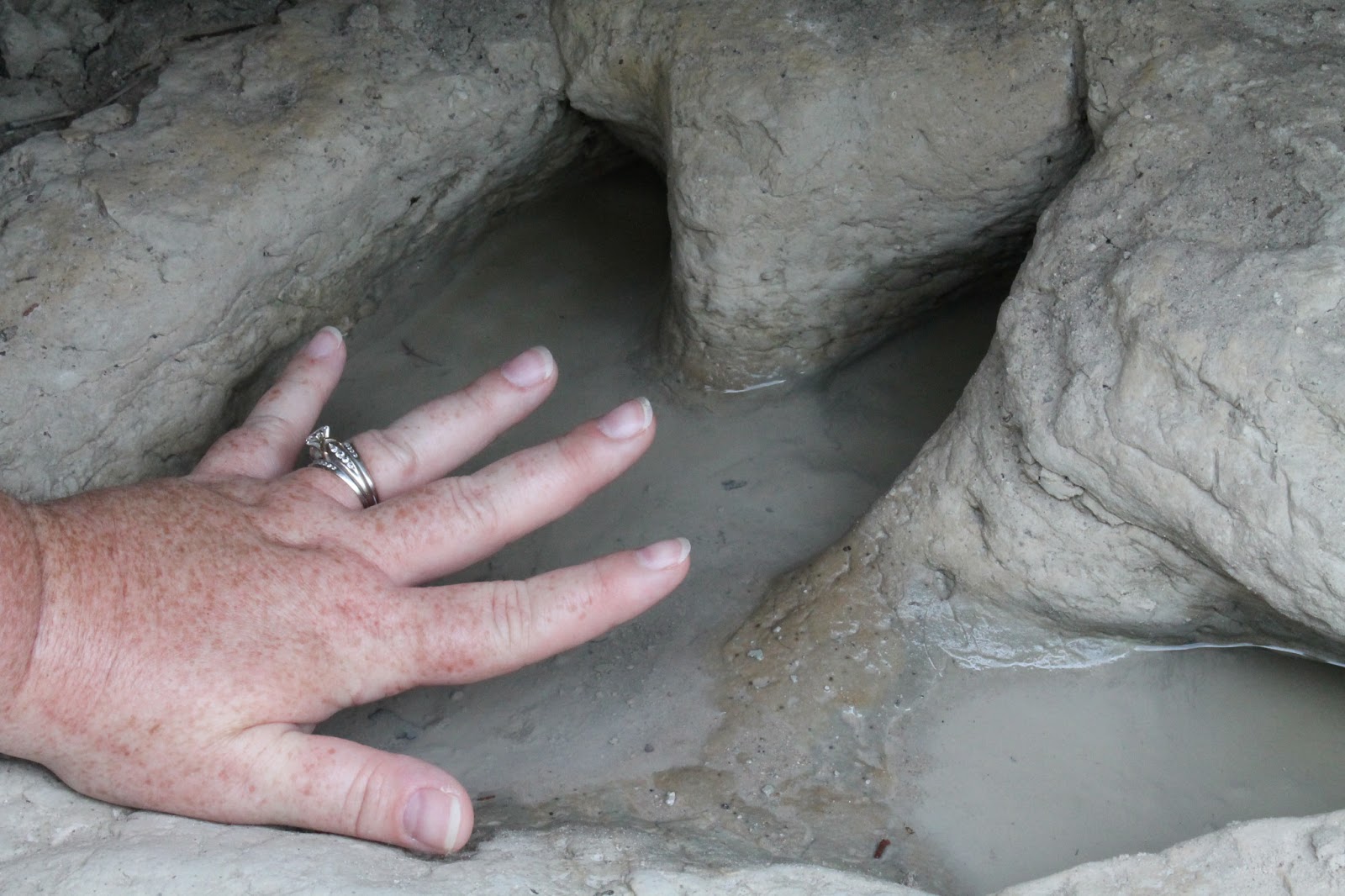
We also drove down into Texas to see dinosaur footprints in the bed of the Paluxy River and visit a creationist museum that is infamous even among creationists.


Notice that, according to the creationist museum, the acrocanthosaur with razor sharp teeth (and which is attacking Mary Kay Johnston, a professor from Austin, TX) was herbivorous.

One could not hope for a better group of participants: high school teachers, both new and retired; college professors, both current and retired; and other interested people. There were ten participants and two instructors, a total of 12 crammed into what we were told was supposed to be a 15 person van.


You can bet that I will be trying to organize more such trips in the future.

I hope you all have as interesting a summer as I am having. And please do not hesitate to post things on this blog that you think we would be interested in hearing.

Stanley Rice
President-elect

Tuesday, April 23, 2013

Spring Field Meeting at Lake Eufala State Park

The Spring Field Meeting was April 19-21 at Lake Eufala. Except for a couple of cold nights for campers, the weather was excellent, just warm enough to be comfortable but cool enough to make hiking around a pleasure, with gentle breezes. It was a late spring, but the buds were open enough to allow botanists to identify trees and shrubs.

On the morning botany field trip, we worked our way downhill from the group camp toward the lake. We spent the better part of an hour looking at the lawn. To many people, it would come as a complete surprise how many species of plants a spring lawn contains. You can walk across an incredible amount of biodiversity in just a step or two. Gloria Caddell helped us to identify these species. Down in the forest, Gloria helped us recognize tristyly in Oxalis violacea, which promotes outcrossing between individual plants.


On the morning and afternoon botany trips, we explored forests, and learned to recognize many species of trees. Thanks to Bruce Smith for helping us to recognize important traits of trees and shrubs and, of course, a few ferns. There were several oak species (we couldn't always distinguish them on the basis of immature leaves). Some tree species have immediately recognizable features such as the horizontal lenticels of black cherry bark and the multiple leaf shapes of sassafras:


In addition to Gloria Caddell and Bruce Smith:


we had contributions from another botanist, Stan Rice, but also from plant pathologist Steve Marek, who helped us find an orange rust fungus that alternates between cedar and crabapple hosts, and a conk mushroom growing out of a dead black locust. We also saw lots of lichens. At least three species are visible in this photo:


The botany field trips were joined by numerous high school and middle school students brought by Russell Hudgens of Tahlequah and Bruce Smith of McLoud, as well as college students such as Amber Fisher from UCO and Nick Owens from Southeastern:


It was two Southeastern students (Tyler Titsworth and Ben Singleton) who noticed that most of the tent caterpillars on a cherry tree were safe and snug inside their tent but that a few of them sat conspicuously outside; and as if they were not conspicuous enough, the caterpillars were twitching wildly! We speculated that this was due to a parasite in the caterpillars that would attract a bird as an alternate host:


There were other wonderful field trips, but I will invite leaders or participants of those trips to post their experiences on this blog, or if you do not have access, send text and photos to srice@se.edu. We also had a wonderful Friday evening presentation by Warren Booth of TU, about parthenogenetic snakes. I had to miss Adam Ryburn's Saturday evening presentation, but he is welcome to tell us about it.

Stanley Rice
President-elect

Tuesday, April 16, 2013

Oklahoma Evolution Road Trip!

Time is running short to register for the Oklahoma Evolution Road Trip! It is May 30 through June 2 and costs $350 which includes travel, accommodations, and most meals. (The cost is $400 if you prefer single accommodations.) This is a real bargain; a recent Big Bend ecotour of similar length cost almost $3000. Home base is the University of Oklahoma Biological Station on beautiful Lake Texoma. We will see fossil deposits, dinosaur footprints, and living trees, and visit creationist museums. There will be plenty of time for discussion. Dr. Stanley Rice and Dr. Gordon Eggleton, both of Southeastern Oklahoma State University, will lead the trip. The tentative deadline is May 3, though we may extend this upon request. Pre-college teachers will receive professional development credit. More information, and registration information, is available at http://www.ou.edu/uobs/evolution.html as well as at Dr. Rice’s blog (http://www.honest-ab.blogspot.com) and website (http://www.stanleyrice.com). If necessary you may attend for just part of the trip, although registration costs remain the same. We’ve talked about evolution; now let’s go see some stunning evidence for it!

The trip is organized by Oklahomans for Excellence in Science Education and is an activity endorsed by OAS. It should be especially valuable for science educators. As always in OESE and OAS events, there will be wonderful people to talk with.

This will not be a creation vs. evolution debate event. When we visit creationist museums, we will listen to them and ask questions, which we will discuss by ourselves later.

Help spread the word to people you know who may be interested. Tax-deductible donations are accepted by the University of Oklahoma Foundation (see the registration website) to help pre-college science teachers.

See you at the Field Meeting! Let's post photos and information about what we see at Lake Eufala after we get home. If you are a board member who has misplaced the login information, contact me (srice@se.edu) and I will send it to you.

Friday, March 22, 2013

Oklahoma Scientist on Talk of the Nation!

I have just finished listening to a Talk of the Nation Science Friday interview of Dr. Charles Brown, a professor at the University of Tulsa. Scientists in Oklahoma can be proud to be well represented by Brown's creative and valuable work.

The immediate subject of the interview was an example of rapid evolutionary change. It appears likely that populations of cliff swallows have evolved over recent decades as a result of roadkills. Swallows killed by vehicles around the bridges where they live had wings that were, on average, longer than the population average of the survivors. Short wings allow greater maneuverability. The apparent conclusion is that vehicles were a selective force that caused the evolution of shorter wings in cliff swallows. Though not surprising to most of us, it probably came as a surprise to many listeners that evolution happens fast enough that we can measure it.

Charles Brown's study are an excellent illustration of something else. He first began collecting roadkill birds without any clear idea of what he would use them for. Once the hypothesis emerged in his mind, however, he had a couple of hundred specimens on which he could make measurements. Scientific research has a certain amount of serendipity. Also, this hypothesis would never have occurred to Charles Brown had he not studied these animals for decades and come to understand nearly every aspect of the social and ecological lives of these animals. A narrow focus, driven by a single answer to a single question, is a process that many scientists use but would never have led Dr. Brown to make this discovery.

Charles Brown spoke in straightforward, friendly language (with an Oklahoma accent). Immediately after his interview, the host interviewed some scientists regarding Gulf War Syndrome. One of the scientists used the term sequelae. I think we all know what this means but it made me wonder how many non-scientists think that scientists speak a different language and live in a different world. They would not have gotten this impression from Brown and his stories about the curious lives of cliff swallows.

Stanley Rice, President-Elect

Monday, March 11, 2013

The Spring Field Meeting at Lake Eufala is coming up! We always have lots of good field trips and it is always good to see our colleagues again. All information, and the registration form, is available at the OAS homepage, in particular at this link for information and this one for registration.

In recent field meetings, we have noticed that spring budburst has been coming earlier and earlier. We had spring field meetings at Sequoyah State Park about 2003 and again in 2012. In 2003, the buds were just opening; in 2012, the leaves were already fully expanded. I have found, in my own database, that buds of many tree species opened 1-2 days earlier every year from 2006 to 2012. I presented these results last fall at the Phenology 2012 conference in Milwaukee. This year has seen a reversal, but not (thus far) a complete one: the buds are still opening earlier this year than in 2008, and much earlier than a decade ago. Whatever happens, there will be plenty of biological activity going on at the field meeting.

Consider offering extra credit for your students to participate. They will have to register, of course. I am offering quite a bit of extra credit to my students in botany courses, but to make sure they pay attention I am requiring that they turn in a brief summary, including the major species that they see.

See you there!
Stan Rice
President-elect

Saturday, November 10, 2012

The Fall Technical Meeting 2012 You Should Have Been There

The Fall 2012 Technical Meeting of the Oklahoma Academy of Science was the place to be on November 9. There were more registrants and more presentations than in many recent meetings. The meeting was at the Nigh Center on the campus of the University of Central Oklahoma at Edmond. It is always inspiring to see such a concentration of talent and passion for science in science students and faculty in our state. Some people think that Oklahoma has little science in it. But they would be wrong, and there is no better place to see it than at the Oklahoma Academy of Science. OAS is grateful to UCO for hosting this meeting.

There were many student and faculty presentations, in over a dozen different fields of science, from botany to zoology to engineering to microscopy to engineering.

Below are some photos of people that you may recognize: Craig Clifford, president, and Valerie O'Brien, secretary; Executive Director David Bass explaining the budget; Sheila Strawn, Ken Hobson, and Adam Ryburn.

Vic Hutchison, Professor Emeritus at OU, gave the keynote presentation. Vic is the grand old man of defending science education in Oklahoma. He told us about the work of Oklahomans for Excellence in Science Education, which for many years has worked against creationist legislation in Oklahoma. Vic and OESE have gained national recognition for these efforts. Creationist legislation has so far been cut down whenever it appears, but it sort of seems like hydra-heads, always reappearing. It looks as if the people who oppose evolution the most do not know what it is, because they have allowed "natural selection" and "change through time" to be included in Oklahoma secondary school teaching standards. OESE has sponsored many workshops for teachers, and has recently expanded into north Texas and will soon focus on global climate change as well as evolution. Oklahoma has been privileged to have Vic Hutchison working for us. The final photo is of his presentation.

Posted by Stanley Rice, president-elect, OAS